Multi-Agent Workflow Architecture: Reliable Systems Under Control
How I used bounded roles, code-led orchestration, durable state, validation, and human gates to keep a complex agent workflow inspectable and recoverable.

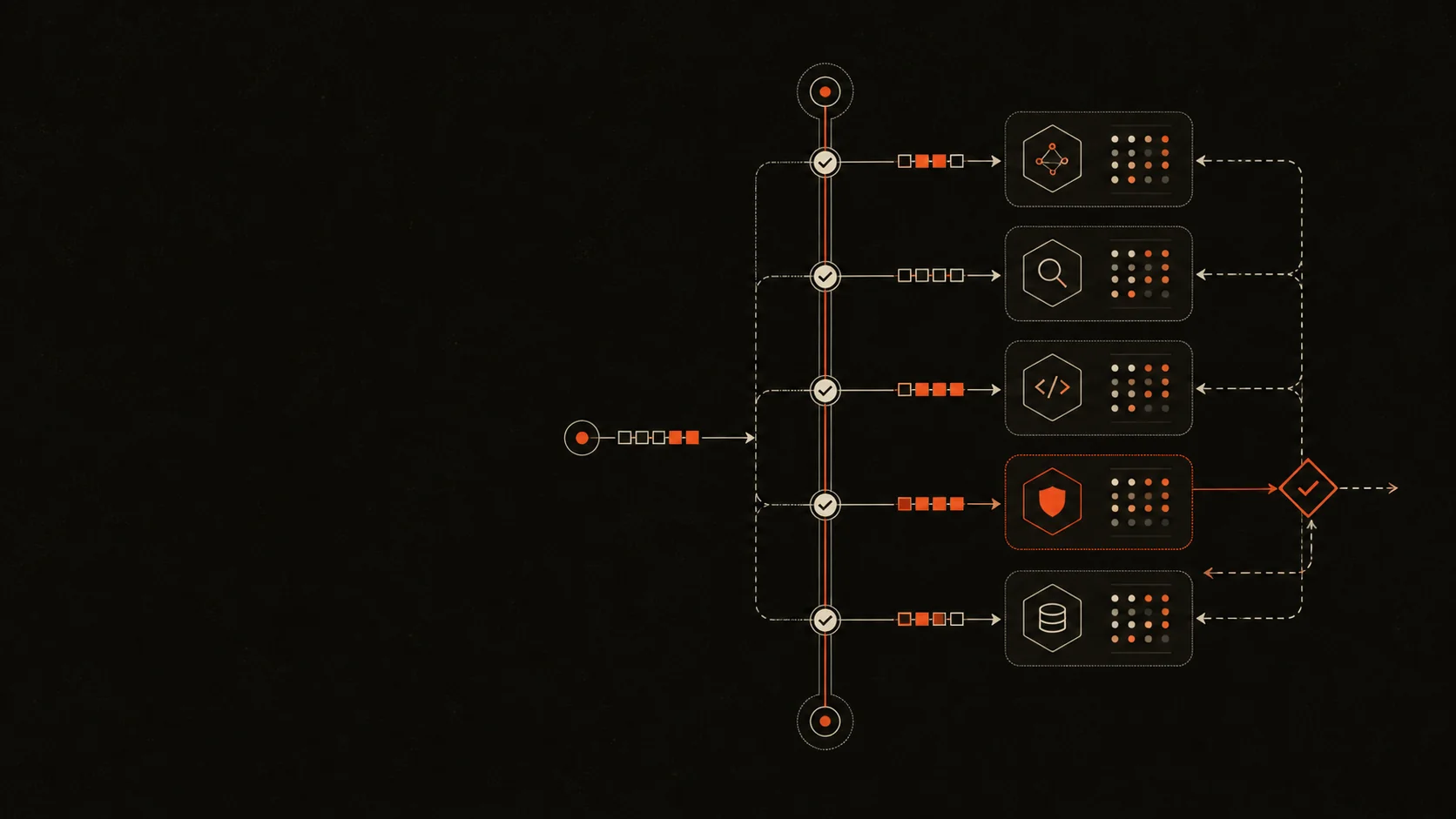
A reliable multi-agent system needs a control plane that can explain what runs next, why it runs, and when it must stop.
A multi-agent workflow architecture fails when nobody can answer a simple question: who owns the next decision?
That was the core constraint behind Seowyn. The platform starts with one website address and turns it into a foundation audit, keyword and competitor research, content assets, campaign planning, and a prioritised 90-day roadmap. The public case study describes a multi-agent pipeline with model routing. The difficult part was never making several models produce text. It was keeping the workflow observable when tasks ran for different lengths, depended on earlier evidence, or failed for different reasons.
My direct answer is this: reliability comes from putting autonomy inside a deterministic control plane. A coordinator owns state and sequence. Specialist agents receive narrow contracts. Every output is validated before it can become another agent's input. Long-running work is queued. Retries have budgets. High-impact or ambiguous results stop at a human gate.
The problem was coordination, not model intelligence
A single model can often complete a surprisingly long task. Splitting work across agents only earns its complexity when the task has distinct reasoning domains, incompatible toolsets, or stages that benefit from parallel execution. OpenAI's agent guidance makes the same point: start with one agent, then split when complex instructions or overlapping tools become difficult to manage [1].
Seowyn crosses that line because a technical audit, keyword discovery, competitor evidence, long-form writing, and a 90-day plan are different jobs. They need different inputs, tools, output formats, and quality checks. Treating them as one enormous conversation would make the run hard to resume, compare, or diagnose.
The architecture therefore separates two kinds of work:
- The control plane decides what may run, what it depends on, how many times it may retry, and what constitutes completion.
- The model plane handles bounded reasoning inside a task contract. It can suggest and synthesise, but it cannot silently redefine the workflow.
The multi-agent workflow architecture

The diagram is deliberately asymmetric. Agents are not peers chatting until they agree. A central coordinator owns the run. That manager pattern is useful when one component must combine specialist outputs and enforce shared controls. OpenAI's orchestration documentation distinguishes this from handoffs, where a specialist takes over the interaction [2].
1. Make each agent sign a contract
An agent should not receive the entire project history and a vague request to help. It should receive a versioned input, an allowed tool set, an output schema, a retry limit, and a clear stop condition. This reduces accidental scope growth and makes failures comparable across runs.
The following is a synthetic, valid JSON example. It illustrates the contract shape and does not expose Seowyn's private prompts or source code.
{ "job_id": "seo_01HXYZ", "task": "keyword_research", "input_refs": ["site_snapshot:v3"], "allowed_tools": ["search_data_api"], "output_schema": "KeywordSetV2", "max_attempts": 3, "requires_human_approval": false}The important detail is that the contract stores references to approved inputs rather than copying an uncontrolled transcript into every prompt. It also gives the validator something concrete to check.
2. Keep business state outside the model conversation
Chat history is context, not a reliable database. The run needs a durable record of task status, input versions, produced artefacts, validation results, attempt count, and reason codes. Seowyn's published stack includes PostgreSQL, Redis, and Celery. That combination supports a useful separation: durable business records belong in the database, while queue messages coordinate work that may be retried or redelivered.
Celery's task documentation warns that tasks should ideally be idempotent because messages can be delivered again. It also supports bounded retries, exponential backoff, and jitter [3]. Idempotency means that running the same task twice with the same inputs does not create unintended duplicate effects.
Database transactions still need care. PostgreSQL's transaction documentation explains how Read Committed gives each command a fresh snapshot, while stronger isolation can reject conflicting work and require the application to retry [5]. In practice, the workflow should use uniqueness constraints, compare-and-set transitions, or row locks where duplicate task claims would be harmful.
3. Parallelise evidence collection, not dependent decisions
Parallel work is useful when tasks do not depend on one another. Audit checks, keyword discovery, and competitor collection may be able to fan out after the website snapshot is ready. The synthesis stage must wait for the required evidence set.
Celery's workflow primitives map cleanly to this idea. A group runs independent tasks in parallel, a chain links dependent steps, and a chord runs a callback only after a group has completed [4]. The documentation also warns that synchronisation has overhead. Parallelism should therefore reflect the dependency graph, not a desire to make the architecture look more agentic.
Control comes from explicit gates
The most important control is not a longer system prompt. It is an executable gate between stages. I use four kinds of gate in this architecture pattern:
- Schema gate. Reject malformed or incomplete output before another task can consume it.
- Evidence gate. Require source references for claims that will influence later recommendations.
- Policy gate. Block actions outside the task's allowed tools, tenant boundary, or data scope.
- Human gate. Pause when the decision is ambiguous, high-impact, irreversible, or intended for publication.
Guardrails are layered. OpenAI's guidance describes input, tool-use, and output guardrails, together with human intervention for sensitive or failure-prone workflows [1]. No single check proves that an answer is correct. The aim is to catch different failure classes at the boundary where they become actionable.
Failure must have a named next state

A generic failed flag is not enough. A timeout, invalid schema, rate limit, missing source, policy rejection, and human-review request have different next actions. Each transition should carry a run ID, task ID, input version, route, attempt count, timestamp, and reason code.
This is also why live progress should be an event stream rather than an optimistic spinner. Seowyn's published stack includes WebSockets. FastAPI's WebSocket support allows a client and server to keep a connection open and exchange messages, which is suitable for pushing state transitions to the interface [6]. The browser should still be able to reload the canonical run state from the API after a disconnect.
What this architecture does not solve
More control does not remove uncertainty. A validator can accept a plausible but weak answer. Two agents can repeat the same source and create false confidence. A model route that worked last month can change after a provider update. Queue delivery guarantees do not automatically make business effects safe.
The architecture limits the blast radius, preserves evidence, and makes a run resumable. It does not guarantee perfect research, rankings, or business outcomes. Model and prompt changes still need versioning and evaluation against representative tasks. Sensitive actions still need explicit authorisation.
What I would keep boring
The durable parts of this system are conventional software: task contracts, state transitions, database constraints, logs, timeouts, retry budgets, and approval queues. Model names can change without forcing the workflow to change. That is the point of model routing, which I discuss in Multi-agent SEO: putting four models on one job. The same discipline appears in shipping fast without shipping junk: define what must stay true before optimising the clever part.
The Seowyn case study shows the product context behind this architecture. Its public workflow starts with one URL and produces twelve deliverables plus a prioritised 90-day roadmap. The reliability lesson is smaller: every autonomous step needs a bounded role, durable state, a validator, and a clear owner when the machine cannot decide.
The lesson
A reliable multi-agent workflow architecture is not a room full of capable agents. It is a controlled sequence of contracts, state transitions, and gates. Code owns the workflow. Models handle the uncertain reasoning inside it. Humans retain authority over the decisions that deserve judgement.
If your team has a multi-step workflow that feels too fragile to automate, send me the workflow through the contact page. I will tell you honestly where agents help, where deterministic code is safer, and where a human should stay in the loop.
References
Full-Stack Developer & AI Engineer
Full-stack developer and AI engineer from Kolkata, India. I build AI agents, automations, and full-stack products that hand growing teams back the hours they lose to busywork. Here I write about what worked, what broke, and what I would do differently.
Connect on LinkedIn